
Accessing Way-Out Realities
by Bruce Kasanoff

In his 1988 book, Stalking the Wild Pendulum, Itzhak Bentov writes that everything vibrates, including our bodies.
In a single second, we have about 14 periods of rest, and 14 periods of movement. The tangible, “real” world we experience is movement, while the periods of rest correspond to a non-material state. “Without change or movement,” he writes, “There is no subjective or objective reality.”
This is where things get intriguing.
He explains that, “Our solid physical reality goes on, as usual, except for tiny pauses, during which our ‘observer’ takes off and comes back. During the out periods, in the other dimensions or realities, an untrained observer comes back without communicating any knowledge of this outing to the mind and the brain. In other words, this experience does not normally reach the conscious thinking level…
“A trained observer (the one who can stay at a high level of consciousness for a while) has, as shown before, managed to stretch his subjective time considerably. Naturally, he may be able to observe and be imprinted with the information he sees. Then, upon his return, he may formulate the imprinted visions into thoughts.”
For most of us, we are only aware of the periods at the bottom of this diagram, when movement is happening. We don’t even notice the 14 rapid instances of rest each second.
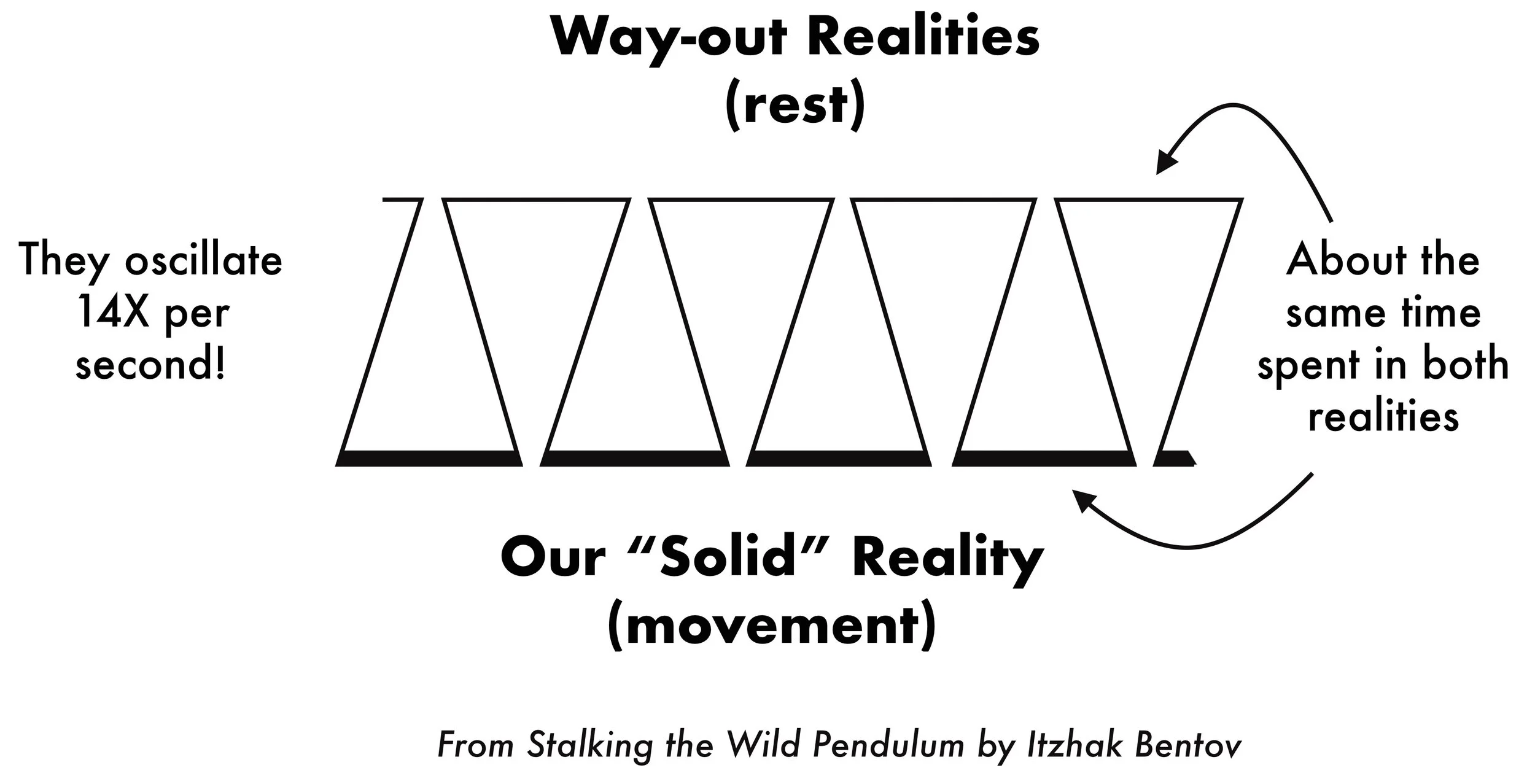
But things are different for someone in an expanded state of consciousness. They can become aware of the periods of rest, and thus they can experience what our society considers to be way-out capabilities and perceptions.
Here’s the part that you might have the greatest challenge accepting: we don’t spent more time in “normal” reality. We spend an equal time in both realities, but in the vast majority of cases, we only notice the “normal” moments.
These transitions happen very quickly, and constantly. In the rest state, our psyche expands at near infinite space… and this is where we can tap into advanced forms of intuitive knowing. In the book, he explains why and how this happens.
Bentov admits that he is merely providing a model for what could be happening; I don’t take everything he describes as perfect information.
That said, his descriptions are the first I’ve heard that explain what the most advanced meditator I know means when he urges me to focus on the still point, where there is no time or space. If the still point happens just as frequently as everything I have ever experienced, then it should be just as easy to let stillness fill my awareness as it is to watch football on TV.